Fiber to Ethernet Converters
Extend Copper Ethernet Links over Optical Fiber
Fiber to Ethernet Converters use a copper transceiver to transform the signal from a UTP / RJ45 Ethernet link to one that can be used by a fiber optic transceiver. These Media Converters are used to enable connections of UTP copper-based Ethernet equipment to various optical fiber cable such as multimode, single mode, or single strand fiber. The benefits include extending Ethernet links over greater distances, protecting data from noise and interference, and future proofing a network with additional bandwidth capacity.
Copper-based Ethernet connections are limited to a data transmission distance of only 100 meters [328 feet] when using unshielded twisted pair (UTP) cable. By using an Ethernet to fiber conversion solution, fiber optic cabling can be used to extend this link over a greater distance. An Ethernet to Fiber Media Converter can also be used where there is high electromagnetic interference (EMI), a common phenomenon found in industrial plants. This interference can cause corruption of data over copper-based Ethernet links. Data transmitted over fiber optic cable is immune to EMI noise, ensuring optimal data transmission across the plant floor.
Fiber to Ethernet Converters by Perle
- Link 10Mbps, 100Mbps, 1G, 2.5G or 10G Copper to Multimode or Single Mode fiber
- Supports Dual Fiber and Single Fiber (SX, FX, LX, EX, ZX, BX) connections and data transmission
- Options for operation in Unmanaged or Secure Managed Networks
- Advanced features & functionality for efficient troubleshooting & less on-site maintenance
- Choose from over 760 models to meet any fiber integration project need
10/100/1000/2.5G/10G

- 10/100/1000/2500/10G to 1G/10G Fiber
- SFP / SFP+ connector options
- Operating temperatures from 0°C to +50°C
10/100/1000 Ethernet

- 10/100/1000 Copper to 100/1000 Fiber
- SFP, SC, ST, or LC connector options
- Operating temperatures from -40°C to +75°C
- Optional PoE up to 100 Watts
10/100 Ethernet

- Convert 10/100 Copper to 100Mbps Fiber
- SFP, SC, ST, or LC connector options
- Operating temperatures from -40°C to +75°C
- Optional PoE up to 30 Watts
10 Gigabit
- Convert 10G Copper to Fiber
- SFP+ or XFP connector options
- Operating temperatures from 0°C to +50°C
Gigabit Ethernet
- Convert 1G Copper to Fiber
- SFP, SC, ST, or LC connector options
- Operating temperatures from -40°C to +75°C
Fast Ethernet
- Convert 100Mbps Copper to Fiber
- SFP, SC, ST, or LC connector options
- Operating temperatures from -40°C to +75°C
Perle Fiber Media Converter Customers


Why Choose a Perle Fiber to Ethernet Converter?

Robust Media Converter
Perle only uses high-end components from leading chip manufacturers to ensure product reliability. Perle's advanced implementation of Link Pass-Through includes an onboard processor that continuously monitors the status of the links and sends a notification if the fiber connection is broken or disconnected.

Cisco Compatible Media Converter
Perle Media Converters are compatible with Cisco switches and routers. As a key component in ensuring the reliability and stability of your network, dependable Media Converters with seamless interoperability are essential.

Reliable Media Converter
Most Media Converter manufacturers do not publish (or make very difficult to find) their MTBF’s. Perle is proud to publish the high MTBF rates in the Specifications for each product. In addition, we provide the best-in-class Lifetime Warranty.

Secure Media Converter
Perle Managed Media Converters support all AAA security services (TACACS+, RADIUS, LDAP, Kerberos, NIS and RSA) used in corporate networks, as well as SSH/SSL, SNMPv3, Telnet, and HTTPS secure management sessions. And the PerleVIEW Central Management Platform simplifies the configuration, administration, monitoring and troubleshooting

Technical Support
We have sales and technical support staff around the globe to support you. If you need help choosing the best Media Converter for your application, we provide technical consultations by phone or email. And, even though Perle Fiber Converters are extremely easy to install and configure, post sales support is easy to contact.

Trust
Perle has been providing reliable device connectivity solutions since 1976. That’s over 40 years of experience that businesses around the globe have come to trust to deliver superior connectivity technology for mission critical applications.
Fiber to Ethernet Applications
More Fiber Media Converters
Industrial

Certified components that will operate in the harshest environmental & temperatures of -40°F to 167°F (-40°C to 75°C).
PoE
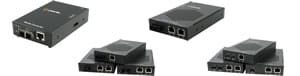
Connect copper to fiber while providing up to 100 Watts of PoE power to IP cameras, VoIP phones, wireless access points and more.
Managed Media Converters

Supports AAA security services (TACACS+, RADIUS, LDAP...) and secure management sessions (SSH/SSL, SNMPv3, HTTPS...)

