Summary
An oilfield services company needed to connect new and existing equipment reliably without retraining field technicians. They deployed Perle IOLAN Terminal Servers across a fleet of data van command centers to convert RS232 serial communications to Ethernet. The solution enabled easy interoperability with new equipment, real-time monitoring of serial data streams, and simplified operations for field staff.
The Problem: Interoperability Gap Between Serial and IP-based Equipment
Modernizing your equipment sounds straightforward until you're in the middle of it. When adding communication protocols, the question is how to do it without disrupting operations.
Perle worked with an oilfield service company that faced this challenge. How could they get current and newly acquired equipment to communicate reliably, while keeping things simple enough that the people on the ground can set things up, fix problems, and move on without extensive training?
The company provides hydraulic fracturing services to major USA oil exploration and production companies. It operates in an industry that relies heavily on established communication technologies, namely RS232 serial using the ASCII protocol, to gather data from sensors in the field. As part of this ongoing effort, the company introduced new equipment that communicates via the MQTT (Message Queuing Telemetry Transport) IP-based protocol.
We have been in the process for the last several years to get better at transmitting data from the field into the office, into our data lake,
says the company’s OT systems supervisor. We saw ourselves in the need to convert all the data into one that could talk to each other, and in this case, it was TCP/IP. We decided to change from serial to TCP/IP so that our data collector was able to ingest both RS232 and MQTT data.
For years, the company used Moxa for serial-to-Ethernet conversion. Moxa boxes are complicated,
says the OT systems supervisor. In the event of a discrepancy, if the guys in the field needed to connect to the Moxa and decipher what needed to be done, it was a lengthy process. There was no way to train them well enough to handle every problem. We needed something easier for the guys to work with.
In an environment that required continuous monitoring of fracking equipment sensors, that troubleshooting burden was unsustainable. They needed a protocol-conversion solution that was powerful enough for the task and simple enough for anyone on site to operate.
Solution: Why the Company Chose Perle IOLANs over Moxa
Perle stood out for one decisive reason: simplicity. As the team moved from serial to TCP/IP, it needed a device server that field technicians could use immediately, without extensive training. Recommended by a trusted internal expert with previous experience using Perle devices, the IOLAN Terminal Server proved intuitive from the start. For the company’s 24/7 oil and gas field operations, the IOLAN Terminal Server met operational requirements while remaining easy for field technicians to use.
Compared to Moxa, I think the IOLAN is an incredible tool.
Implementation: How IOLAN Terminal Servers Are Deployed Across the Data Van Fleet
The company has more than 30 data vans in its fleet. In addition to the equipment, it houses the personnel responsible for real-time oversight and analysis of sensor data. All equipment processes must stay within predefined limits to prevent catastrophic and costly damage.
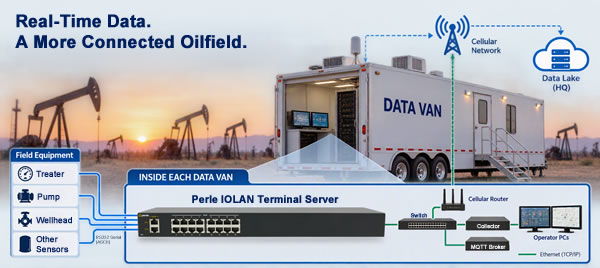
The IOLAN Terminal Server was inserted into this data path to convert the serial data to Ethernet and forward it to a network switch. From there, the data moves to the collector and, via a cellular router, to the data lake at HQ for further monitoring and analysis.
The IOLAN Terminal Server reduces risk, improves response time during anomalies, and helps the company maintain continuous, precise control during fracking operations.
Technical Architecture
- Protocol converted: RS232 serial (ASCII) → Ethernet (TCP/IP)
- Conversion device: Perle IOLAN Terminal Server (rack-mounted, per van)
- Key feature used: Protocol conversion (Serial to TCP/IP)
- Data monitored: Wellhead pressure, pump rate, etc. (continuous)
Results
- Before: Field technicians required specialized training to operate device servers and diagnose connectivity issues; troubleshooting could be lengthy and costly.
- After: Any on-site technician can configure and troubleshoot the IOLAN Terminal Server independently from day one.
Compared to Moxa, I think the IOLAN is an incredible tool. It is easy to use and gives excellent results. We're really happy with the IOLANs. We love them. And everybody, especially in the field, recognized their simplicity, and they started giving us the thumbs up.
— OT Systems Supervisor
IOLAN Terminal Servers: A simple, reliable conversion solution
The company’s experience highlights a challenge many industrial operators face as serial infrastructure collides with IP-based systems: the need for a solution that is both technically capable and operationally straightforward. By deploying IOLAN Terminal Servers across its fleet of data vans, it gave field technicians a tool they could confidently use from day one. In high-stakes environments where continuous monitoring is non-negotiable, simplicity and reliability aren't a luxury. If your organization is navigating a similar mix of serial and IP-based equipment, Perle's IOLAN Terminal Servers are worth a closer look.