How to Maximize Data Center Uptime and Security with Console Servers?
By Bastien Leclair Demand Generation Specialist July 15, 2026
At a Glance
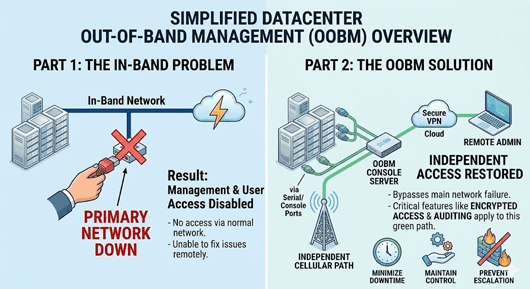
When outages, misconfigurations, or cyberattacks block access to critical infrastructure, Out-of-Band Management (OOBM) and console servers provide a secure, independent access path to diagnose and recover systems remotely. Combined with encryption, centralized authentication, and audit controls, they significantly reduce downtime, maintain control, and prevent incidents from escalating.
The rise of smart technologies, IoT, and artificial intelligence... In the last twenty years, technology and the digital economy have evolved considerably, shaping a world where connectivity is key. Permanent uptime has become a non-negotiable in every daily or commercial activity.
Data is everywhere and the base of everything. In the background, data centers are the backbone of all operations. Whether hosting cloud services, enterprise applications, or critical infrastructure, the expectation for data centers is clear: maximum uptime and uncompromising security. Achieving this requires more than just robust hardware and redundant power supplies; it demands intelligent management systems, secure access protocols, and the ability to respond to issues remotely and efficiently.
Console servers and centralized management platforms play a pivotal role in this strategy, offering a lifeline when traditional network paths fail and enabling proactive control over complex environments. One question is at the forefront of every network administrator's mind: How can I keep my data center in line with my uptime and security goals?
Ensuring Uptime: Beyond Redundancy
Uptime in a data center is often associated with redundancy—dual power feeds, backup generators, failover clusters, and mirrored storage. While these are essential, they don’t address the operational realities of managing hundreds or thousands of devices. Network switches, firewalls, routers, and servers can all experience software crashes, configuration errors, or hardware faults. When these occur, especially outside of business hours, the ability to remotely access and recover devices becomes critical.
Consider a scenario where a core switch fails due to a misconfigured firmware update. Without out-of-band access, the network team may be unable to log in or even reboot the device remotely, losing valuable time in achieving network recovery.
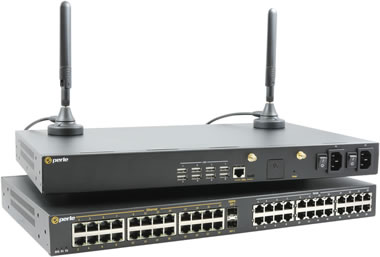
Perle’s IOLAN SCR Console Servers used in combination with a centralized management platform, deployed in the cloud or on premises, provide secure remote device access and management through a single application. You will get maximum uptime for your existing equipment and, with Zero Touch Provisioning (ZTP), fast and simplified configuration, administration, and deployment of all network devices without manual intervention.
Common Causes of Data Center Downtime
Misconfigured firmware or software updates
Hardware faults (such as network switch or router failures) and power disruptions
Configuration errors during maintenance windows
Cyberattacks affecting network accessibility
Securing the Infrastructure: Defense in Depth
Security in data centers is multi-layered, encompassing physical access, network segmentation, identity management, and data protection. Console servers contribute to this defense-in-depth strategy by providing secure access to critical infrastructure, even when the primary network is compromised.
A real-world example: during a cyberattack, hackers may disable network interfaces or disturb routing tables to block administrative access. If the only way to manage devices is through the production network, recovery becomes nearly impossible. However, with a console server in place, administrators retain a secure, isolated channel to access and remediate affected systems. This capability is vital during incidents, where every minute of downtime can translate into lost revenue and reputational damage.
A good console server must support encrypted protocols such as SSH, SSL, and VPN, ensuring that remote sessions are protected from interception. It should also integrate with enterprise authentication systems like LDAP, RADIUS, and TACACS+, enabling role-based access control and multi-factor authentication. These features prevent unauthorized access and ensure that only verified personnel can interact with sensitive systems.
Audit logging and session recording further enhance security by providing a detailed trail of who accessed what, when, and what actions were taken. This is invaluable for compliance with the highest security standards, and for forensic analysis in the event of a breach.
Security Features Required in Modern Console Servers
Feature
Purpose
Benefit
Built-in Firewall
Secure network access
Protect inside networks from intrusions
Network Segmentation
Share information safely
Place shared resources in a demilitarized zone (DMZ)
Full AAA Security
Centralize authentication
Tighten access control and user management
Global Cellular Integration
Provide network redundancy
Protect your data centre against wired LAN failure
Session Recording
Record remote sessions
Provide accountability and troubleshooting visibility
Out-of-Band Management and Operational Efficiency
Beyond uptime and security, console servers and centralized management platforms offer significant gains in operational efficiency. Managing a distributed data center environment, especially across multiple sites or colocation facilities, can be resource-intensive. Console servers eliminate the need for physical presence, allowing engineers to perform diagnostics, configuration changes, and reboots from anywhere in the world.
Perle Centralized Management Platforms provide a single pane of glass for managing all console servers, streamlining tasks such as firmware updates, port configuration, and user access control. This reduces administrative overhead and minimizes human error, which is a leading cause of outages.
Imagine a situation where a firmware bug causes a firewall to lock up during a routine update. Without remote access, the only solution may be a manual power cycle, requiring someone to physically visit the data center. With centralized console access, the administrator can log in, assess the issue, and reboot the device remotely, restoring service in minutes.
Operational Benefits of Centralized Management
Remote diagnostics and troubleshooting
Centralized firmware management
Reduced need for on-site technicians
Faster response during outages and maintenance
Lower operational costs for distributed environments
Reduced risk of human error
Improved agility for DevOps and IT teams
Avoiding Catastrophes with Proactive Management
The absence of console servers and centralized management can lead to avoidable catastrophes. These include prolonged outages due to inaccessible devices, delayed incident response, and increased exposure to cyber threats. In worst-case scenarios, businesses may suffer data loss, SLA violations, or regulatory penalties, all of which can be mitigated or avoided with the right infrastructure.
For example, a data center hosting financial services experiences a network outage during a peak trading window. The root cause is a misconfigured router that cannot be accessed via the production network. Without out-of-band access, the outage persists for hours, impacting transactions and triggering client complaints. With a console server in place, the issue could have been resolved in minutes, preserving uptime and customer trust.
Similarly, during a DDoS attack, administrators may need to reconfigure firewalls or reroute traffic. If access to these devices is blocked, the response is delayed, and the attack causes greater disruption. Console servers provide a secure fallback path, enabling rapid intervention and minimizing impact.
Risks of Operating Without Out-of-Band Management
Without Console Servers
With Console Servers
Recovery during outages is delayed
Faster remote recovery and troubleshooting
Technicians need to be dispatched on-site
Access remote infrastructure securely
Visibility is limited during cyber incidents
Set up an independent management path during attacks
Operational costs are higher
Improve operational efficiency
Increased risk of SLA violations
Reduced downtime and service disruption
Best Practices for Maximizing Data Center Uptime and Security
Use encrypted remote management protocols such as SSH and VPN
Implement centralized authentication using LDAP, RADIUS, or TACACS+
Enable audit logging and session recording
Use centralized management platforms for visibility and control
Reduce dependency on physical intervention during outages
Plan for disaster recovery and cyber incident response
Automate provisioning and configuration using Zero Touch Provisioning (ZTP)
Console Servers : your clear path to Uptime and Security
In an era where data centers underpin critical business functions, the importance of uptime, security, and remote management cannot be overstated. Console servers and centralized management platforms are strategic assets that enable resilience, agility, and control. By investing in IOLAN SCR Console Servers from Perle, organizations can avoid costly downtime, strengthen their security posture, and empower their teams to operate efficiently across any environment.
When responding to a cyber incident, recovering from a hardware failure, or simply performing routine maintenance, every second counts and downtime is not acceptable. The ability to access and manage critical equipment on your network infrastructure quickly and remotely is key to the success and performance of your business as a whole.
Key Takeaways
Out-of-Band Management (OOBM) provides an independent management path to access infrastructure devices when the primary production network becomes unavailable.
Console servers provide secure remote access to routers, switches, firewalls, and servers during outages, configuration errors, or cyber incidents, helping organizations reduce downtime.
Console servers support encrypted protocols, centralized authentication, role-based access control, multi-factor authentication, audit logging, and session recording to secure administrative access.
Centralized management platforms streamline firmware updates, device configuration, access control, and remote troubleshooting across distributed environments.
Zero Touch Provisioning (ZTP) automates the deployment and configuration of network devices without manual intervention, reducing setup time and operational complexity.
Perle IOLAN SCR Console Servers
Perle’s IOLAN SCR Console Servers provide secure remote access and centralized management capabilities for modern data center infrastructures.
Key Capabilities
Secure Out-of-Band Management
Cloud-based or on-premises centralized management
Zero Touch Provisioning (ZTP)
Support for SSH, SSL, VPN, LDAP, TACACS+, and RADIUS
Remote troubleshooting and device recovery
Scalable management for distributed environments
Read more about the IOLAN SCR Console Servers, or Book a demo!
The role of OOBM Console Servers to Maximize Uptime and Security in Data Centers.