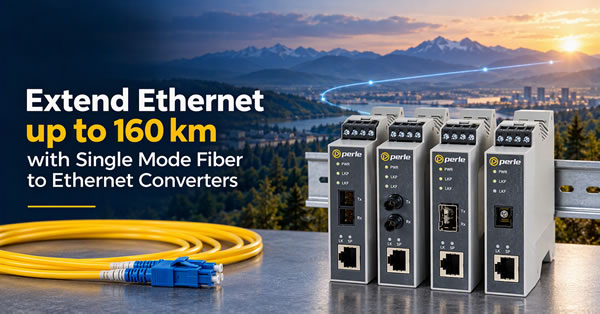
Extend Ethernet up to 160 km with Single Mode Fiber to Ethernet Converters
By Alex Pirvulescu Director of Product Management, Perle Systems November 17, 2026
TL;DR: Single mode fiber-to-Ethernet converters extend Ethernet connectivity far beyond the 100 m (328 ft.) limit of copper cabling, with products supporting distances of up to 160 km (100 mi.). Learn how fiber type, optical transceivers, and link budgets affect maximum reach and what features to consider when selecting a fiber media converter for long-distance network deployments.
Single mode fiber is the preferred choice when a network needs to carry data over long distances with low attenuation and high bandwidth. It is widely used for campus backbones, telecommunications infrastructure, data center interconnects, utility networks, and broadcast applications.
The challenge is that much of the equipment at either end of a fiber link still uses copper Ethernet interfaces. In existing installations, copper cabling may already be in place at the network edge. In new installations, copper Ethernet can be a practical and cost-effective choice for shorter connections. Switches, security cameras, wireless access points, industrial devices, and other edge equipment commonly provide copper Ethernet ports, while fiber-capable ports are often available only on specific models or configurations.
Standard copper Ethernet connections are typically limited to 100m over balanced twisted-pair cabling. Beyond that distance, you need an appropriate extension technology, such as fiber, to provide reliable Ethernet connectivity.
This is where single mode fiber media converters come in. They bridge the gap between copper Ethernet equipment and long-distance fiber infrastructure, allowing existing or cost-effective copper-based devices to connect to a single mode fiber network without replacing the endpoint equipment with fiber-capable models.
Single Mode Fiber and Multimode Fiber: What’s the Difference?
Single mode fiber uses a small core that carries light along a single transmission path. This minimizes modal dispersion and enables high-bandwidth transmission over much longer distances than multimode fiber. The trade-off is that single mode optics can cost more, particularly for longer-reach applications.
Multimode fiber has a larger core that supports multiple transmission paths. It is well suited to high-speed data transmission over shorter distances and can provide a cost-effective solution for many enterprise and data center applications. Because different propagation modes can arrive at slightly different times, modal dispersion limits the maximum distance over which multimode fiber can reliably transmit data. Depending on the fiber grade, transceiver, and data rate, multimode fiber can support distances of up to approximately 550m for certain Gigabit Ethernet applications.
If your application requires single mode fiber, the next consideration is whether to use single-fiber or dual-fiber connectivity.
Single-fiber connections use one fiber strand for both transmitting and receiving data, typically through wavelength-division multiplexing (WDM), also known as BiDi. The transmit and receive signals operate on different wavelengths, enabling simultaneous bidirectional communication over the same fiber. Dual-fiber connections use two separate fiber strands, one for transmitting and one for receiving.
For long backbone links, WDM/BiDi single-fiber media converters can reduce fiber requirements and potentially lower cabling and deployment costs. However, they require complementary optical wavelengths at each end of the link.
The primary advantage of single-fiber connectivity is reduced fiber consumption. Dual-fiber connectivity, by contrast, generally provides broader interoperability and a wider choice of compatible optics and equipment.
Because infrastructure projects often combine different fiber types, speeds, distances, and connector configurations, choosing a media converter vendor with a broad portfolio of single mode and multimode, single-fiber and dual-fiber solutions can simplify deployment and future expansion.
How Far Can a Single mode Media Converter Reach?
A Copper-to-Fiber Media Converter is a practical way to extend Ethernet over long-distance fiber while maintaining standard Ethernet connectivity. Depending on the model and optical transceiver selected, single mode fiber-to-Ethernet media converters can support links of up to 160 km, far beyond the typical 100 m limit of copper Ethernet cabling.
The required transmission distance determines the appropriate fiber type, optical transceiver, and media converter. Maximum reach depends on factors including the Ethernet standard, operating wavelength, transmit power, receiver sensitivity, fiber attenuation, connector and splice losses, and the overall optical power budget.
For Gigabit Ethernet, common long-distance single mode options include:
1000Base-LX/LH (1310 nm): up to 10 km (6 mi.) for standard LX; vendor-specific LH implementations may support significantly longer distances up to 40 km (25 mi.)
1000Base-EX (1310 nm): typically up to 40 km (25 mi.)
1000Base-ZX (1550 nm): typically 70, 120 or 160 km (43, 75 or 100 mi.), depending on the optical power budget and the specific transceiver implementation.
For higher-speed applications, 10 Gigabit Ethernet optics can provide long-distance connectivity as well, depending on the transceiver standard and implementation.
10GBASE-LR: up to 10 km (6 mi.)
10GBASE-ER: up to 40 km
10GBASE-ZR: up to 80 km (50 mi.).
Before selecting a fiber media converter, determine the total link distance, then choose a media converter with an optical transceiver designed for that distance.
The installed cable length alone does not determine the maximum supported distance.
The optical transceiver and available link budget are equally important. For example, a 160 km link requires an appropriate long-reach optical transceiver with sufficient transmit power, receiver sensitivity, and optical power budget. Conversely, a 40 km-rated fiber cable does not necessarily require a 40 km-rated transceiver. If the actual link is only 5 km, a shorter-reach transceiver may be sufficient, provided the fiber type, wavelength, connectors, and optical power budget are compatible. Always check the fiber media converter and transceiver specifications against the actual link requirements before ordering.
Choosing a Single mode Converter for Long-Range or Backbone Use
Beyond distance, several practical considerations should also guide your selection:
Unmanaged single mode media converters are simple, plug-and-play, and cost-effective for straightforward point-to-point connectivity. However, "unmanaged" does not have to mean "no visibility." Some unmanaged converters provide remote monitoring and diagnostic capabilities, allowing network administrators to monitor link status and detect certain fault conditions without deploying a fully managed solution. Before purchasing, determine what level of monitoring and diagnostics your deployment requires and verify those capabilities in the manufacturer's specifications. Selecting a basic unmanaged converter when remote visibility may be needed can create unnecessary troubleshooting challenges later.
Managed fiber media converters
provide the visibility, security, and remote management capabilities needed for critical fiber infrastructure. Network administrators can monitor link status, detect faults, and troubleshoot remotely using SNMP, alarms, and diagnostics such as link pass-through and far-end fault. Enterprise-grade models may also support secure management protocols such as SNMPv3, SSH, and HTTPS, together with centralized AAA authentication through platforms such as RADIUS and TACACS+. Depending on the platform, additional authentication options may include LDAP, Kerberos, NIS, or RSA.
Industrial-rated and harsh environment fiber media converters are designed for deployments where equipment may be exposed to extreme temperatures, like -40°C to 75°C (-40°F to 167°F) or other demanding environmental conditions. However, not all wide-temperature ratings are equivalent. When evaluating equipment for harsh environments, verify that the components used in the product are appropriately rated, qualified, and tested for the full specified operating temperature range. For particularly demanding applications, look for products with certifications appropriate to the deployment environment, including substation and hazardous-location certifications where required.
Power over Ethernet (PoE): if the remote endpoint requires power, consider a PoE fiber media converter. Fiber carries the data, while the converter supplies electrical power locally over the copper Ethernet connection to the connected Powered Device (PD). Depending on the model, PoE media converters can support IEEE 802.3af, 802.3at, or IEEE 802.3bt. Models supporting IEEE 802.3bt Type 4 can provide up to 100 W per port to compatible high-power devices such as PTZ cameras, wireless access points, and other Ethernet-powered equipment. This architecture allows fiber to provide long-distance data connectivity while the media converter supplies power locally at the remote end.
How to Choose a Single mode Fiber Media Converter Vendor
Choosing the right vendor involves more than comparing maximum distance. Asking the right questions helps ensure that the selected solution meets both the immediate deployment requirements and future network needs.
Requirement
Questions to Ask a Vendor
Fiber Architecture
Do your media converters support single-fiber or dual-fiber deployments, or both?
Fiber Type
Do they support both single mode and multimode fiber?
Distance
What is the supported distance for each converter and optical transceiver?
Speed
What Ethernet speeds are supported, from 10/100 Mbps through 1G and 10G?
Fiber / Optics
Which wavelengths, optical transceivers, and link budgets are supported?
Interfaces
Which copper and fiber interfaces are available, including RJ45, SFP, and SFP+?
Management
Are both managed and unmanaged solutions available?
Diagnostics
What monitoring, fault detection, and troubleshooting features are provided?
PoE
Are PoE models available, and what IEEE PoE standards and power levels are supported?
Industrial Use
Are industrial-temperature models available? Are products available with substation or hazardous-location certifications?
Deployment Scale
Are standalone and high-density modular chassis solutions available?
Support
What technical support and engineering assistance is available?
Lifecycle
How long are products supported, and what is the product lifecycle strategy?
Warranty
What warranty coverage is provided?
How to Choose a Single mode Fiber Media Converter
Selecting the right converter requires matching its capabilities to the existing network infrastructure and the requirements of the planned deployment.
Requirement
What to Determine
Fiber Configuration
Single-fiber (BiDi/WDM) or dual-fiber
Fiber Type
Single mode or multimode
Distance Required
10 km to 160 km or other required distance
Ethernet Speed
10/100 Mbps, 10/100/1000 Mbps, 1G, 2.5G, 5G, or 10G, depending on application and converter
Connector Type
SC, ST, or LC
Wavelength / Optics
Standard duplex optics or paired WDM/BiDi wavelengths
Optical Budget
Verify transmit power, receiver sensitivity, fiber attenuation, and connector/splice losses
Device Interface
RJ45, SFP,or SFP+
Management
Managed monitoring and remote management: Yes / No
Diagnostics
Link monitoring, link pass-through, far-end fault, alarms, etc.
PoE
PoE required: Yes / No
Industrial Temperature
Extreme-temperature operation required: Yes / No
Certifications
Substation, hazardous-location, railway, or other application-specific certification required: Yes / No
Deployment Method
Standalone, DIN rail, rack-mount, or modular chassis
FAQ
When a network needs to connect multimode fiber on one side to single mode fiber on the other, two approaches are common. The appropriate solution depends on whether the application requires protocol transparency or is dedicated to Ethernet.
SFP-to-SFP fiber mode converters
connect two fiber links back-to-back using the appropriate SFP transceivers. By selecting SFPs for the required fiber type, wavelength, speed, and distance, they can convert between multimode and single mode fiber while remaining protocol transparent. This makes them a flexible solution for applications where the converter must pass the underlying protocol transparently.
Ethernet fiber mode converters are purpose-built for Ethernet networks. They convert multimode-to-single mode fiber while regenerating, reshaping, and retiming the Ethernet signal before transmitting it over the other fiber link. This makes them well suited to Ethernet network extension and fiber-mode conversion applications.
Yes. Fiber carries data but not electrical power. A PoE media converter converts the copper Ethernet connection to fiber for long-distance data transmission while also providing local power to the connected device over the copper cable. The converter is powered locally by an AC or DC power source and acts as Power Sourcing Equipment (PSE).
Depending on the model, a PoE media converter can support up to 100 W per port using IEEE 802.3bt Type 4 for compatible Powered Devices (PDs), including PTZ cameras, wireless access points, and other high-power Ethernet devices.
In practical terms, the fiber carries the data over long distances while the media converter supplies power locally at the remote end, close to the device being powered. This eliminates the need to transmit electrical power over the fiber link while allowing copper-powered devices to be deployed far from the network switch.
Yes. Single mode media converters are available for Gigabit Ethernet and 10 Gigabit Ethernet higher-speed applications, depending on the converter and optical transceiver.
For Gigabit Ethernet, common long-distance options include 1000BASE-LX, 1000BASE-EX, and extended-reach 1000BASE-ZX implementations, with transmission distances ranging from approximately 10 km to 160 km depending on the selected optics and link budget.
Two common approaches:
Fixed-rate or fixed-interface fiber media converters provide a defined Ethernet interface and fiber interface. They are generally straightforward to deploy and are well suited to applications where the network interfaces operate at the same Ethernet speed.
Rate-converting fiber media converters can support different Ethernet speeds on the copper and fiber interfaces, depending on the model. For example, a 10/100/1000 Mbps copper port can connect a lower-speed Ethernet device to a Gigabit fiber backbone. This can be particularly useful when integrating legacy or lower-speed equipment into a higher-speed fiber infrastructure.
For higher-bandwidth applications, look for media converters supporting 10 Gigabit Ethernet and SFP+ optical interfaces.
Yes. If a switch has a copper RJ45 uplink port, a single mode fiber-to-copper media converter can connect that copper uplink to a single mode fiber backbone.
For example, a copper-only Ethernet switch can be connected to a single mode fiber backbone using a media converter. The converter connects to the switch's RJ45 uplink port and converts the electrical Ethernet signal to an optical signal for transmission over the single mode fiber.
At the other end, the fiber can connect directly to a fiber-enabled switch or to another media converter, depending on the network architecture.
This allows a copper-only switch to communicate over a single mode fiber backbone to another switch, the network core, or a remote building, extending the uplink well beyond the distance limitations of copper Ethernet.
The media converter provides transparent copper-to-fiber Ethernet connectivity without changing the Ethernet traffic.
Find the right Single Mode Fiber Media Converter for your needs.
Explore Perle's single mode fiber media converter solutions for
long-distance Ethernet connectivity.